For years, SEO has been a race to the top of Google’s search results. Today, a different race has begun: the race to become the source AI trusts enough to cite.
The rise of Artificial Intelligence is changing how people discover information online. Instead of clicking through pages of search results, users are increasingly asking platforms such as ChatGPT, Gemini, Claude and Perplexity direct questions and expecting complete, reliable answers within seconds.
For businesses, this creates a new challenge.
It is no longer enough to ask, “How do we rank higher on Google?”
The more important question is:
“Why would an AI system choose our content over thousands of other sources?”
The answer is not as simple as keywords, backlinks or even search rankings.
In fact, many websites that rank well in traditional search rarely appear in AI-generated responses, while some less prominent websites are regularly referenced because they demonstrate something more valuable than rankings alone.
They demonstrate confidence.
AI Doesn’t Think Like a Search Engine
One of the biggest misconceptions surrounding AI Search is the belief that Large Language Models simply copy Google’s search results.
They don’t.
Search engines primarily retrieve and rank webpages based on hundreds of established signals. AI systems, however, are designed to generate answers by analysing information, identifying patterns, comparing multiple sources and producing responses that users can trust.
This is a subtle but important distinction.
Google’s challenge has always been:
“Which page is most relevant to this search?”
AI’s challenge is different:
“Which information is trustworthy enough to become part of my answer?”
That single shift changes how businesses should think about digital visibility.
Trust Is Becoming the New Ranking Signal
Although no AI provider has published an official list of factors that influence AI citations, one observation has become increasingly difficult to ignore.
The websites that repeatedly appear in AI-generated responses usually have one thing in common.
They have earned trust.
Not through one optimisation tactic.
Not through one technical improvement.
But through the consistent combination of high-quality content, recognised expertise, technical excellence, semantic clarity and strong brand authority.
Think of trust as a puzzle rather than a single ranking factor.
Every helpful article, every authoritative backlink, every expert author, every accurate statistic, every well-implemented piece of structured data and every positive brand mention adds another piece to that puzzle.
Eventually, the picture becomes clear not just for people, but for AI systems as well.
Why Rankings Alone Are No Longer Enough
Imagine two companies publishing an article about the same topic.
The first article is well optimised for keywords and ranks highly in search results. However, it offers little original insight, has no named author, cites few reliable sources and has not been updated for several years.
The second article may receive less traffic initially, but it is written by an experienced specialist, supported by credible references, regularly reviewed, structured for machine readability and forms part of a wider knowledge hub covering the subject in depth.
Which article would you trust?
More importantly, which article would an AI system feel confident referencing?
Increasingly, the answer is the second.
Visibility in AI-powered search is becoming less about publishing more content and more about publishing content that deserves to be trusted.
The Rise of AI Citation Confidence
At Reposition, we’ve spent months analysing how authoritative brands create content that performs well across both traditional search and emerging AI experiences.
One pattern continues to stand out.
The most visible organisations are not necessarily those chasing every algorithm update.
They are the organisations building AI Citation Confidence.
We use this term to describe the collective level of confidence your website earns through hundreds of interconnected quality signals.
These signals include the expertise behind your content, the authority of your brand, the clarity of your website’s structure, the accuracy of your information and the consistency of your digital presence.
No single signal guarantees an AI citation.
However, together they create an environment where your content becomes easier to understand, easier to trust and more likely to be referenced.
What We’re Learning About AI Search
The more we study AI Search, the clearer one principle becomes.
Search Engine Optimisation, Answer Engine Optimisation (AEO) and Generative Engine Optimisation (GEO) are not competing disciplines.
They are converging.
Technical SEO still matters because AI systems need to discover and understand your content.
High-quality writing still matters because AI prefers information that genuinely helps users.
Brand authority still matters because trust extends far beyond your website.
Structured data still matters because machine-readable content is easier to interpret.
The businesses seeing the greatest success are those that treat these elements as one connected strategy rather than separate marketing activities.
Introducing The 100 AI Search Signals™
As we continued researching this shift, we realised that businesses needed a practical way to understand what contributes to AI visibility.
That thinking led us to develop The 100 AI Search Signals™ Reposition’s evolving framework for evaluating how prepared a website is for AI-powered search.
It is not an attempt to reverse-engineer AI algorithms.
Nor is it a checklist promising guaranteed citations.
Instead, it brings together the practical signals that help organisations build trust, improve machine readability, strengthen semantic relevance and increase what we call AI Citation Confidence.
Over the coming months, we’ll be exploring each area of the framework in greater depth, sharing practical guidance, real-world examples and actionable recommendations to help businesses prepare for the future of search.
The Future of Search Belongs to Trusted Sources
Every major shift in search has rewarded businesses that focused on creating genuine value rather than chasing shortcuts.
AI Search is no different.
The organisations that succeed won’t necessarily be those publishing the most content or targeting the most keywords.
They’ll be the ones that consistently demonstrate expertise, answer real questions, build recognised brands and create information that both people and machines can trust.
Search is evolving.
Trust isn’t.
If there’s one lesson businesses should take into the next generation of search, it’s this:
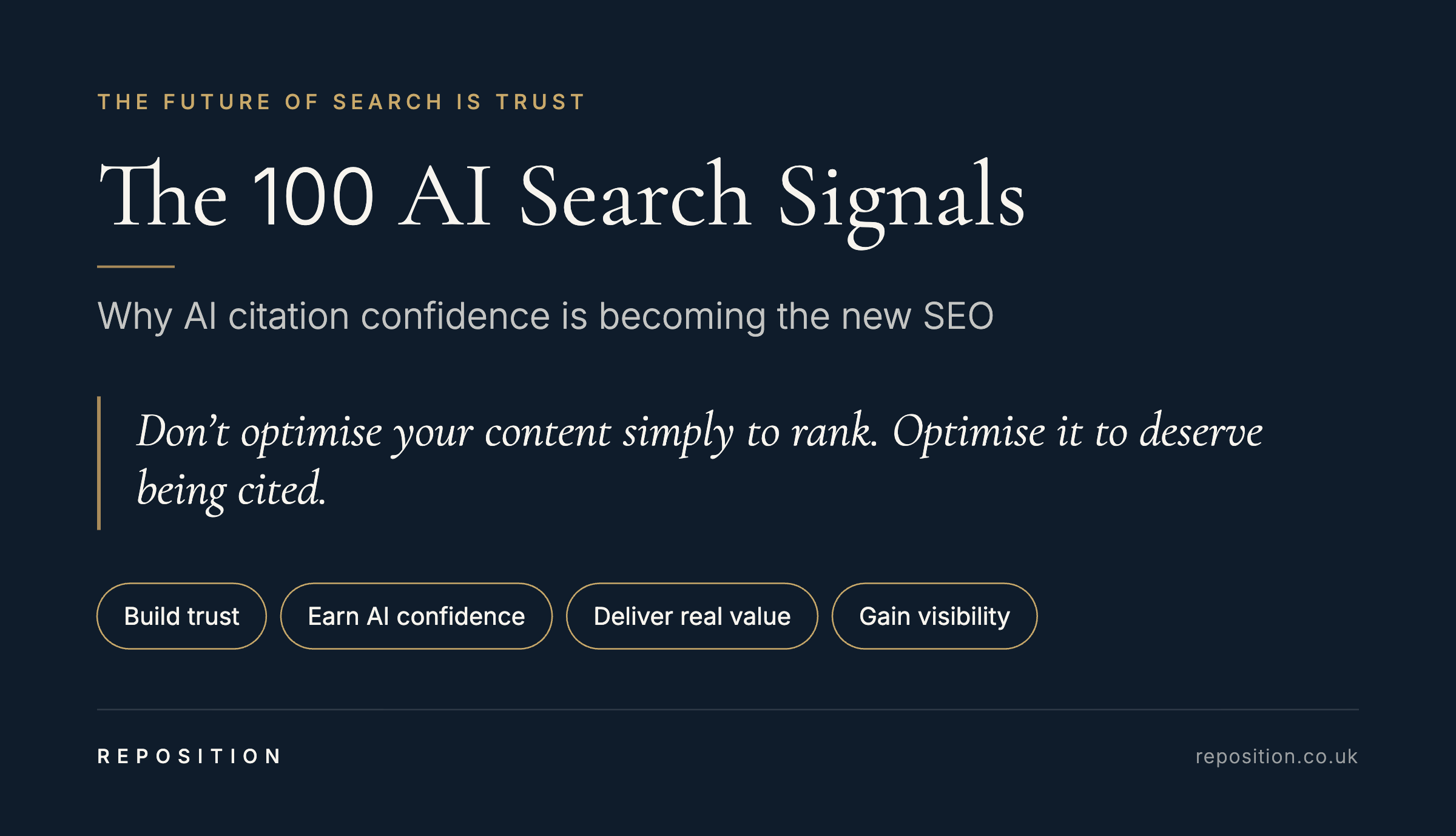
Don’t optimise your content simply to rank. Optimise it to deserve being cited.
Because in the age of AI, the brands that earn confidence will ultimately earn visibility.
Continue the Conversation
This article introduces the thinking behind The 100 AI Search Signals™. In our next guide, we’ll explore the framework in more detail and explain how businesses can assess their own AI readiness using practical optimisation principles drawn from SEO, AEO and GEO.
Until then, ask yourself one simple question:
If an AI system had to answer your customers’ most important question today, would it have enough confidence to cite your website?