This guide is written for marketing directors, business owners and in-house teams evaluating SEO partners in the UK. It covers the evaluation criteria that distinguish high-performing agencies from average ones, what a properly structured SEO engagement looks like, how to interpret results, what modern SEO companies must now do differently to perform in AI-driven search, and the questions that reveal whether an agency truly understands its craft.
How the Role of an SEO Company Has Changed in 2024–2025
The expectations placed on an SEO company have shifted materially over the past two years. Three changes in particular define what separates agencies that are still delivering from those that have become obsolete.
1. Google AI Overviews Have Restructured the Results Page
Since Google began rolling out AI Overviews in the UK in 2024, a significant proportion of commercial and informational queries now return an AI-generated summary above traditional organic results. Ranking in position one no longer guarantees the visibility it once did if the AI Overview occupies the top of the page and is drawn from other sources.
A competent SEO company in 2025 must understand how AI Overviews select source material favouring pages with direct, clearly structured answers, strong E-E-A-T signals, schema markup, and content that directly addresses the user’s query intent without padding and must actively optimise for citation within those summaries, not just for traditional blue-link rankings.
2. LLMs Have Become a Discovery Channel
A growing segment of the buying population now uses large language models ChatGPT, Claude, Gemini, Perplexity as their primary research tool before engaging with a business. These systems do not crawl in real time; they are trained on and retrieve from web content that meets a high threshold of clarity, authority and factual specificity.
This means the content strategy a good SEO company builds today must serve two audiences simultaneously: Google’s indexing systems and the training and retrieval pipelines of major LLMs. Content that is well-structured, factually dense, clearly attributed and semantically precise performs in both environments. Generic, padded or keyword-stuffed content performs in neither.
3. Core Web Vitals and Page Experience Are Now Table Stakes
Technical performance page speed, visual stability, interactivity is no longer a differentiator; it is a baseline requirement. Any SEO company that is not routinely auditing and improving Core Web Vitals scores as part of its standard engagement is already behind. Google’s ranking systems actively suppress slow, unstable pages regardless of content quality or link authority.
What Separates a High-Performing SEO Company from an Average One
The UK SEO market contains hundreds of agencies. The performance gap between the best and the rest is substantial. The following criteria are the most reliable indicators of a genuinely high-performing provider.
Commercial Attribution, Not Vanity Metrics
Average agencies report on rankings and organic traffic. High-performing agencies report on revenue, leads and pipeline value attributable to organic search. The distinction matters enormously.
An SEO company that cannot demonstrate how its work connects to commercial outcomes using Google Analytics 4 goal completions, CRM data or e-commerce revenue attribution is either not measuring what matters or is deliberately obscuring underperformance behind metrics that are easy to inflate.
Proprietary Methodology, Not Template Delivery
The best SEO companies develop their own frameworks based on accumulated data across client accounts. They know, for example, which technical fixes drive the fastest ranking recovery in competitive sectors, which content formats generate the highest rate of AI Overview citation, and how to prioritise a backlink strategy against a specific competitive landscape.
An agency operating from a generic monthly checklist ‘publish two blogs, build five links’ is not doing strategy. It is doing activity. The two look similar from the outside but produce very different results over twelve months.
Technical Depth Beyond Surface-Level Audits
A surface-level technical SEO audit identifies crawl errors and slow pages. A deep technical audit identifies why a JavaScript-heavy site is only partially rendering for Googlebot, how a faceted navigation system is creating thousands of duplicate URLs, or why hreflang implementation on a multi-region site is directing incorrect language versions to wrong markets.
The depth of technical SEO capability is often the sharpest differentiator between agencies, because it requires genuine engineering-adjacent knowledge that cannot be replicated with off-the-shelf tools alone.
Content Built for Both Humans and AI Systems
In 2025, content strategy must address three distinct parsers: human readers, Google’s ranking algorithms, and AI retrieval systems (including the models used by Perplexity, ChatGPT and Google AI Overview). Content optimised only for one of these tends to underperform across the others.
The structural requirements for AI citability are specific: direct answers in the opening sentences of each section, question-format headings that mirror search queries, factual specificity with named entities and dates, short paragraphs with single clear points, and FAQPage or HowTo schema to explicitly signal content type to Google’s systems.
Transparent, Accessible Reporting
Data ownership must sit with the client, not the agency. A reputable SEO company provides clients with direct access to all performance data Google Analytics, Search Console, rank tracking and does not operate from locked-down proprietary dashboards that disappear if the engagement ends.
Monthly reporting should be forward-looking as well as retrospective: what happened, why it happened, and what the next 30–60 days of activity is designed to achieve. Agencies that use reporting calls to present slides without connecting the data to upcoming decisions are filling time rather than adding value.
How to Evaluate an SEO Company: A Structured Framework
Stage 1 — Assess Evidence of Results
Before any conversation about methodology or pricing, ask for case studies with verified metrics. The case study should specify the starting position, the actions taken, the timeline and the commercial outcome — not just a percentage increase in traffic presented without context.
Reliable case study evidence includes:
- Named client (or industry + company size if anonymised), with dates
- Baseline metrics before the engagement began
- Specific actions taken, not just categories of work
- Commercial outcomes: revenue, leads, conversions — not traffic alone
- Timeline from start to result
Be sceptical of case studies showing very rapid results for highly competitive national terms. Legitimate sustained growth takes three to twelve months. Case studies showing overnight transformation typically involve either low-competition terms or misleading before/after date selection.
Stage 2 — Evaluate Technical Competence
Ask the agency to conduct a brief technical review of your website as part of the pitch process. A strong technical SEO company will identify real, specific issues not generic observations that apply to every site and will be able to explain the mechanism by which each issue is suppressing rankings or crawl performance.
Questions that reveal technical depth:
- ‘What is our largest crawl efficiency problem and how would you resolve it?’
- ‘How is our JavaScript rendering affecting indexation?’
- ‘What Core Web Vitals issues are currently hurting our rankings and what are the root causes?’
- ‘Are there any indexation anomalies in our Search Console data that concern you?’
Shallow answers to these questions ones that describe symptoms without diagnosing causes indicate an agency operating from tool outputs rather than genuine technical understanding.
Stage 3 — Test Their Content and AI Overview Strategy
Ask the agency directly: ‘How do you approach content strategy for Google AI Overview citation and LLM visibility?’ This is a question that was not relevant two years ago. An agency that cannot answer it substantively is not current.
A credible answer should reference:
- Structured content architecture: pillar pages, topic clusters and supporting content built around semantic relationships
- Direct-answer formatting: opening sentences that answer the query without requiring the reader to scroll
- Schema markup strategy: FAQPage, HowTo, Article and Organisation schema as standard
- E-E-A-T signals: named authorship, cited sources, expert review processes
Entity optimisation: ensuring the business and its key topics are clearly represented as named entities in Google’s Knowledge Graph
Stage 4 — Scrutinise Their Link Acquisition Approach
Backlink strategy is where the gap between ethical and unethical agencies is most pronounced, and where the consequences of poor practice are most severe. A manual penalty resulting from a manipulative link-building campaign can take months to recover from.
Acceptable link acquisition methods in 2025 include digital PR (data-led campaigns pitched to journalists), expert commentary outreach, original research publication, and content-led link earning. Unacceptable methods include bulk link purchases, private blog network (PBN) placements, link exchanges and low-quality directory submissions at scale.
Stage 5 — Clarify Reporting, Ownership and Exit Terms
- Who owns the content, links and data produced during the engagement?
- What access will you retain if the contract ends?
- How is performance measured, and against which KPIs agreed at the outset?
- What is the notice period and are there lock-in clauses?
- Who specifically will work on the account day-to-day, and what is their experience level?
The last point matters more than many clients realise. It is common for senior staff to conduct the pitch and junior staff to run the account. Ask to meet the person who will actually manage your campaign before signing.
What a Well-Structured SEO Engagement Looks Like
The following describes what a professional SEO engagement should deliver at each stage. Use this as a benchmark when reviewing proposals or assessing an existing agency relationship.
| Phase | Timeframe | What Should Be Delivered | Warning Signs |
|---|---|---|---|
| Onboarding and audit | Weeks 1–3 | Detailed technical audit with prioritised action list; access to all analytics and tracking tools confirmed; KPIs and baseline metrics agreed in writing | Generic audit that could apply to any website; no baseline metrics set; immediate promises about rankings |
| Strategy and roadmap | Week 3–4 | 90-day roadmap connecting specific activities to specific commercial outcomes; content gap analysis; competitive landscape review | Activity list without commercial rationale; no competitor analysis; no defined success criteria |
| Technical implementation | Months 1–3 | Critical technical fixes deployed and verified in Search Console; crawl coverage improving; Core Web Vitals green or improving measurably | Recommendations issued but not implemented; no verification that fixes are live; no CWV measurement |
| Content and authority building | Months 2–6 | Topic cluster content published on schedule; internal linking structure improved; first link acquisitions verified | Generic blog posts with no clear strategic purpose; links from irrelevant or low-quality domains; content not indexed promptly |
| Measurement and iteration | Ongoing monthly | Commercial KPI progress reported; algorithm updates assessed and communicated; next 30-day plan presented with rationale | Vanity metrics only; no mention of commercial outcomes; no response to algorithm changes; reactive rather than proactive communication |
Industry-Specific SEO Considerations UK Businesses Need to Know
The technical principles of SEO apply universally, but their strategic application varies significantly by sector. The following outlines the key decision points by industry.
Legal, Financial and Healthcare (YMYL Sectors)
Google classifies legal, financial and medical content as YMYL – Your Money or Your Life because inaccurate information in these areas can cause genuine harm. The algorithmic consequences are severe: YMYL pages without strong, verifiable E-E-A-T signals are actively suppressed.
For businesses in these sectors, the SEO company must build content written or reviewed by named, qualified professionals not generalist copywriters. Author credentials must be verifiable (professional register entries, LinkedIn profiles, published work). The investment in credentialled authorship is not optional in these sectors; it is the single most important ranking factor.
E-Commerce (Scale, Duplication, Revenue Focus)
The primary technical challenge in e-commerce SEO is duplicate content generated by product filtering, sorting and pagination. A site with 10,000 products can easily generate 100,000 URL variants, most of which dilute crawl budget and confuse indexing. Resolving this through canonical tags, parameter handling rules and crawl directives is foundational to everything else.
Commercial strategy should be revenue-led, not traffic-led. An SEO company working on e-commerce should be able to identify which category pages drive the highest revenue per organic visitor and prioritise those for technical and content investment, rather than chasing traffic from broadly popular terms with low purchase intent.
SaaS and B2B Technology (Intent Hierarchy Matters)
In SaaS, the most commercially valuable organic traffic comes from bottom-of-funnel queries: ‘[competitor] alternative’, ‘[product category] software for [use case]’, ‘[product name] vs [competitor]’. These pages convert at significantly higher rates than top-of-funnel awareness content but are often ignored by agencies that default to high-volume keyword targeting.
A good SEO company for a SaaS business builds an intent hierarchy awareness, consideration, decision and allocates content investment proportionally to commercial value at each stage, rather than chasing traffic for its own sake.
Multi-Location and Franchise Businesses
Multi-location SEO requires a systematic approach to local landing pages, Google Business Profile management and citation consistency that scales without creating duplicate content across location pages. The most common failure is creating hundreds of near-identical location pages with only the city name changed a pattern Google’s systems identify and penalise.
Each location page must offer genuinely differentiated content: local team information, locally relevant case studies, area-specific service details and locally earned reviews. This requires a content investment that many businesses underestimate at the outset.
How a Good SEO Company Optimises for Google AI Overviews and LLM Visibility
This is the area where the gap between current and outdated SEO practice is most visible. AI Overview optimisation is not a separate discipline from SEO it is what good SEO now requires by default.
How Google AI Overviews Select Source Content
Google’s AI Overviews do not simply pull from the top-ranking organic results. Research into AI Overview source attribution consistently shows that they draw from pages that demonstrate three qualities above all others: direct, specific answers to the query; clear structural organisation; and verifiable expertise signals.
A page ranking in position three that opens with a precise, factually specific answer to the query is more likely to appear in the AI Overview than a page ranking in position one that opens with a general introduction and buries the substantive answer in paragraph four.
Schema Markup as an AI Signal
FAQPage schema, HowTo schema and Article schema all function as explicit signals to Google’s systems about the type and structure of content on a page. A page with correctly implemented FAQPage schema that contains direct answers to real search queries is substantially more likely to be surfaced in AI Overviews than an identical page without schema.
In 2025, schema implementation is not a technical nicety it is a content visibility mechanism. Any SEO company that does not routinely implement and audit structured data as part of its standard workflow is leaving measurable AI Overview presence on the table.
Entity Authority and the Knowledge Graph
LLMs and Google’s AI systems understand the web in terms of entities named people, organisations, places, products and concepts and the relationships between them. A business that is clearly represented as a named entity in Google’s Knowledge Graph, with consistent mentions across authoritative sources, will appear more reliably in AI-generated responses than one that exists only as a domain name.
Building entity authority involves: ensuring the business has a verified Google Business Profile and Wikipedia or Wikidata presence where appropriate; being consistently mentioned by name in authoritative publications; having team members with credentialled online profiles; and producing content that explicitly names and links to related entities in the same field.
The Difference Between Ranking and Being Cited
Traditional SEO optimises for ranking position. AI Overview optimisation adds a second objective: being the source that the AI system chooses to cite when constructing its answer. A business can achieve both simultaneously when content is structured correctly, but they require different strategic thinking.
Ranking is primarily determined by relevance, authority and technical quality. Citation by AI systems adds: structural clarity, factual specificity, direct-answer formatting, E-E-A-T verification signals and schema markup. An SEO company that understands this distinction builds content with both objectives in mind from the outset.
How to Measure Whether Your SEO Company Is Performing
Many businesses do not realise their SEO agency is underperforming until significant budget has been spent. The following metrics and review cadences allow for earlier identification of underperformance.
Month 1–3: Process Metrics
In the early months, results are not yet visible in rankings or traffic. What should be visible is evidence of rigorous process:
- Technical audit completed and prioritised action list delivered
- Critical technical fixes implemented and verified in Search Console Coverage report
- Core Web Vitals baseline established and improvement plan in place
- Content strategy documented with topic clusters, keyword targets and publishing schedule
- Baseline organic traffic, rankings and conversion data agreed and recorded
If these deliverables have not been produced by month three, the engagement is behind before it has started.
Month 3–6: Leading Indicators
Between months three and six, the following leading indicators should show directional improvement even before significant commercial impact is felt:
- Organic impressions growing in Google Search Console (more queries triggering the site)
- Crawl coverage improving (fewer excluded pages in the Search Console Index report)
- Target keyword ranking positions moving from page three or four towards page two or one
- Content published on schedule with improving click-through rates from Search Console
- First high-quality backlinks acquired and confirmed in a link profile report
Month 6–12: Commercial Outcomes
From month six onwards, commercial impact should be measurable. The benchmark varies by sector and competitiveness, but the following should be demonstrable:
- Organic traffic growing year-on-year, with the growth rate accelerating
- Organic channel contributing measurably to lead volume or e-commerce revenue
- Target commercial pages ranking on page one for primary keyword targets
- Organic cost-per-acquisition declining as traffic grows without proportional cost increase
AI Overview citations visible for brand-related and category queries (verifiable manually)
Red Flags at Any Stage
| Behaviour | What It Indicates |
|---|---|
| Reporting only on rankings and traffic, never on leads or revenue | Agency is optimising for optics, not commercial outcomes |
| Recommendations delivered but not implemented after 60+ days | Agency lacks implementation capability or client relationship management |
| No response to major Google algorithm updates | Agency is not monitoring the landscape or does not know how to respond |
| Link report shows links from irrelevant, low-authority domains | Link building is outsourced or volume-driven, not quality-driven |
| AI Overview presence declining without explanation or action plan | Agency is not tracking or optimising for AI-driven search visibility |
| Account manager changes without notification or proper handover | Retention problems or over-stretched delivery team |
Twenty Questions That Reveal Whether an SEO Company Knows Its Craft
The following questions are designed to surface genuine capability. Evasive, generic or overly salesy answers to these questions are meaningful signals.
On Results and Evidence
- Can you share a case study where you measurably improved organic revenue not just traffic for a business comparable to ours? What was the timeline?
- Have any of your clients been negatively impacted by a Google core update in the past 12 months? If so, how did you diagnose it and what did you do?
- What is the average organic traffic growth rate across your client portfolio over the last 12 months?
On Technical SEO
- How do you approach JavaScript SEO, and how do you verify that dynamically rendered content is being indexed correctly?
- What is your process for managing crawl budget on a large e-commerce site?
- How do you diagnose and resolve Core Web Vitals failures caused by third-party scripts?
On Content and AI Visibility
- How do you structure content to maximise the likelihood of appearing in Google AI Overviews?
- What schema markup do you implement as standard, and how do you verify it is working?
- How do you build topical authority, and how do you measure when it has been achieved?
- How does your content strategy differ for YMYL sectors compared with non-YMYL sectors?
On Link Building
- What percentage of your link acquisition comes from digital PR versus outreach versus other methods?
- Can you show us examples of links earned for clients in the past 90 days with the referring domain and acquisition method?
- How do you identify and handle toxic links in an existing backlink profile?
On Process and Transparency
- Who will manage our account day-to-day, and how many accounts do they currently manage?
- How do you prioritise recommendations when a client’s development team has limited capacity?
- What does your monthly reporting look like, and can we see an example report?
- If we end the engagement, what data, content and access do we retain?
On Commercial Understanding
- How will you connect your SEO activity to our CRM or revenue data?
- What is a realistic commercial outcome for our business and sector within 12 months, and what are the key assumptions behind that estimate?
- If our budget is insufficient to compete effectively in our sector, will you tell us and what would you recommend instead?
Algorithm Updates: What a Good SEO Company Does Differently
Google releases thousands of algorithm updates annually. Most are minor and cause negligible disruption. Major core updates typically four to six per year can produce significant ranking changes across entire sectors. How an SEO company responds to these updates is one of the clearest indicators of its capability.
Before an Update: Building Resilient Sites
The best protection against algorithm updates is building a site that Google’s systems are designed to reward: technically clean, genuinely helpful content with verifiable expertise signals, and a natural backlink profile earned through merit. Sites built this way are resilient by design, not by luck.
An SEO company that focuses on gaming specific ranking signals rather than building genuine quality is creating fragility not growth. When Google updates its systems to better detect the very signals being gamed, the site drops.
After an Update: Diagnosis Before Action
The most common mistake following a significant ranking drop is reactive action without diagnosis. Changing content, removing links or restructuring pages without understanding why rankings dropped is as likely to make things worse as better.
A professional response involves: identifying which pages dropped and for which query types; cross-referencing the drop timing against Google’s confirmed update rollout dates; analysing whether the issue is technical (indexing, crawl), content quality (thin, duplicated, low E-E-A-T) or link-related (manual action, unnatural pattern detection); and then designing a specific remediation plan targeted at the actual cause.
Common Mistakes Businesses Make When Hiring an SEO Company
- Choosing on price alone: The cheapest retainer in a competitive sector will not move rankings. It will produce activity without results and waste twelve months of potential growth.
- Not defining success criteria upfront: Without agreed KPIs at the outset, there is no objective basis for evaluating performance. An agency can always find a metric that looks positive.
- Hiring a generalist agency for a specialist need: A full-service digital agency that offers SEO alongside social media, PPC and web design is unlikely to have the depth of SEO specialism required for competitive markets.
- Ignoring the implementation gap: An SEO company can deliver excellent recommendations that never get implemented because the client’s development resource is committed elsewhere. Scoping implementation capacity before the engagement begins avoids this.
- Short contract horizons in competitive sectors: A three-month trial in a competitive market will not produce meaningful results. Agencies know this, and some use short initial contracts to collect fees before the inevitable non-renewal. Realistic minimum commitments in competitive sectors are six to twelve months.
- Not verifying who actually does the work: The pitch team and the delivery team are frequently different people. Ask specifically who will manage the account, meet them before signing, and understand how many other accounts they are running simultaneously.
- Conflating activity with output: An agency that sends weekly update emails about tasks completed is demonstrating activity. What matters is whether rankings, traffic and commercial outcomes are improving. Active agencies that produce no commercial results are not good value at any price.
High-Performing vs. Average SEO Company: At a Glance
| Area | High-Performing SEO Company | Average SEO Company |
|---|---|---|
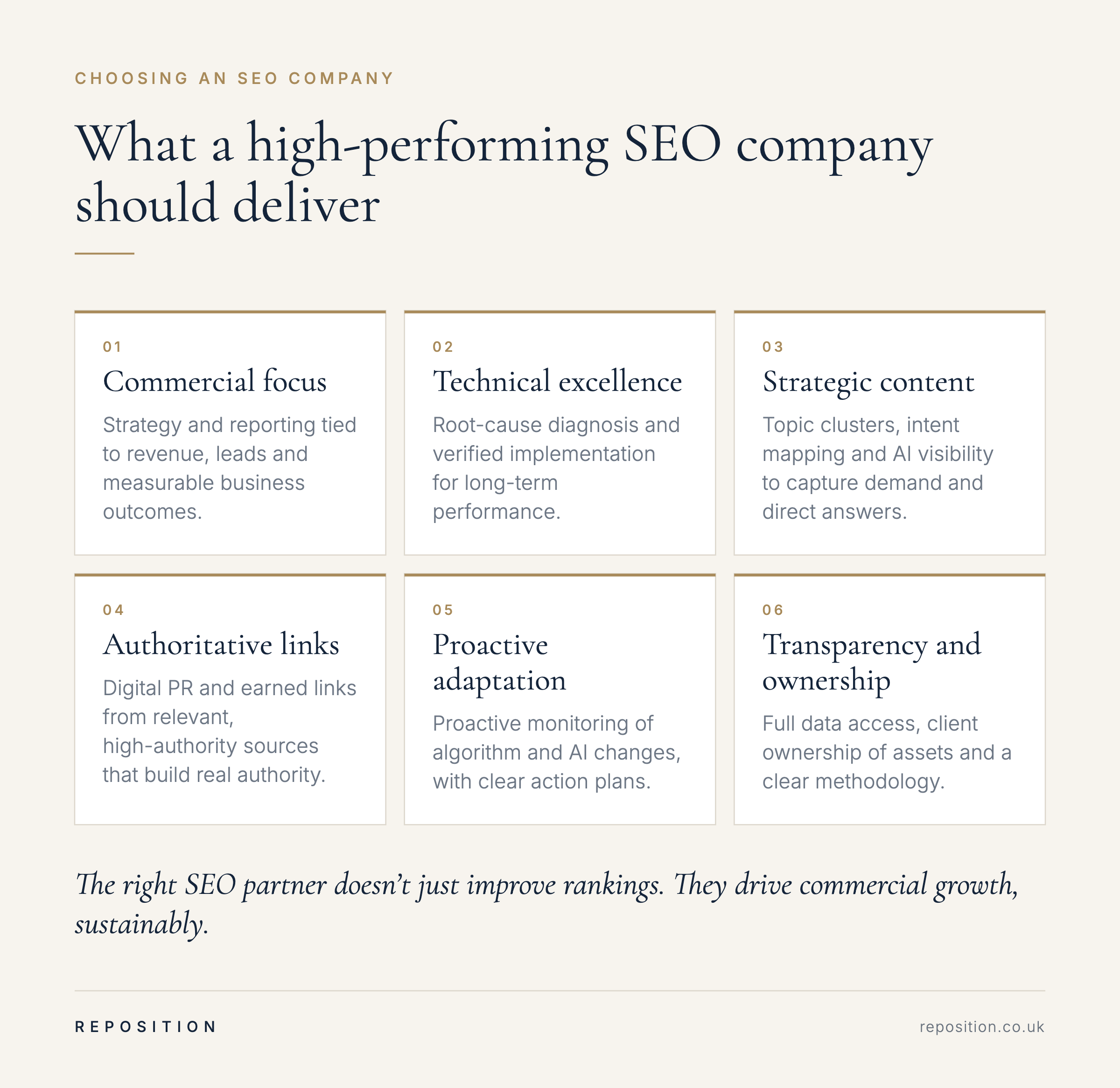
| Reporting | Revenue, leads and organic conversions with attribution methodology | Rankings and traffic volume without commercial connection |
| Technical SEO | Root-cause diagnosis; implementation verified in Search Console | Surface-level audit; recommendations without implementation tracking |
| Content strategy | Topic clusters, intent mapping, AI Overview and LLM optimisation | Blog posts based on keyword volume without strategic architecture |
| Link building | Digital PR, earned links from authoritative relevant sources | Volume-driven outreach; low-relevance directories; opaque sourcing |
| Algorithm updates | Proactive communication; diagnosis-led response plan | Reactive or silent; generic advice to “improve content quality” |
| AI visibility | Schema markup, direct-answer formatting, entity authority building | No specific AI Overview or LLM citation strategy |
| Transparency | Full data access; client owns all assets; clear methodology | Locked dashboards; agency retains data on departure; vague process |
| Commercial honesty | Will advise if budget is insufficient for stated goals | Will take any budget regardless of realistic outcome |