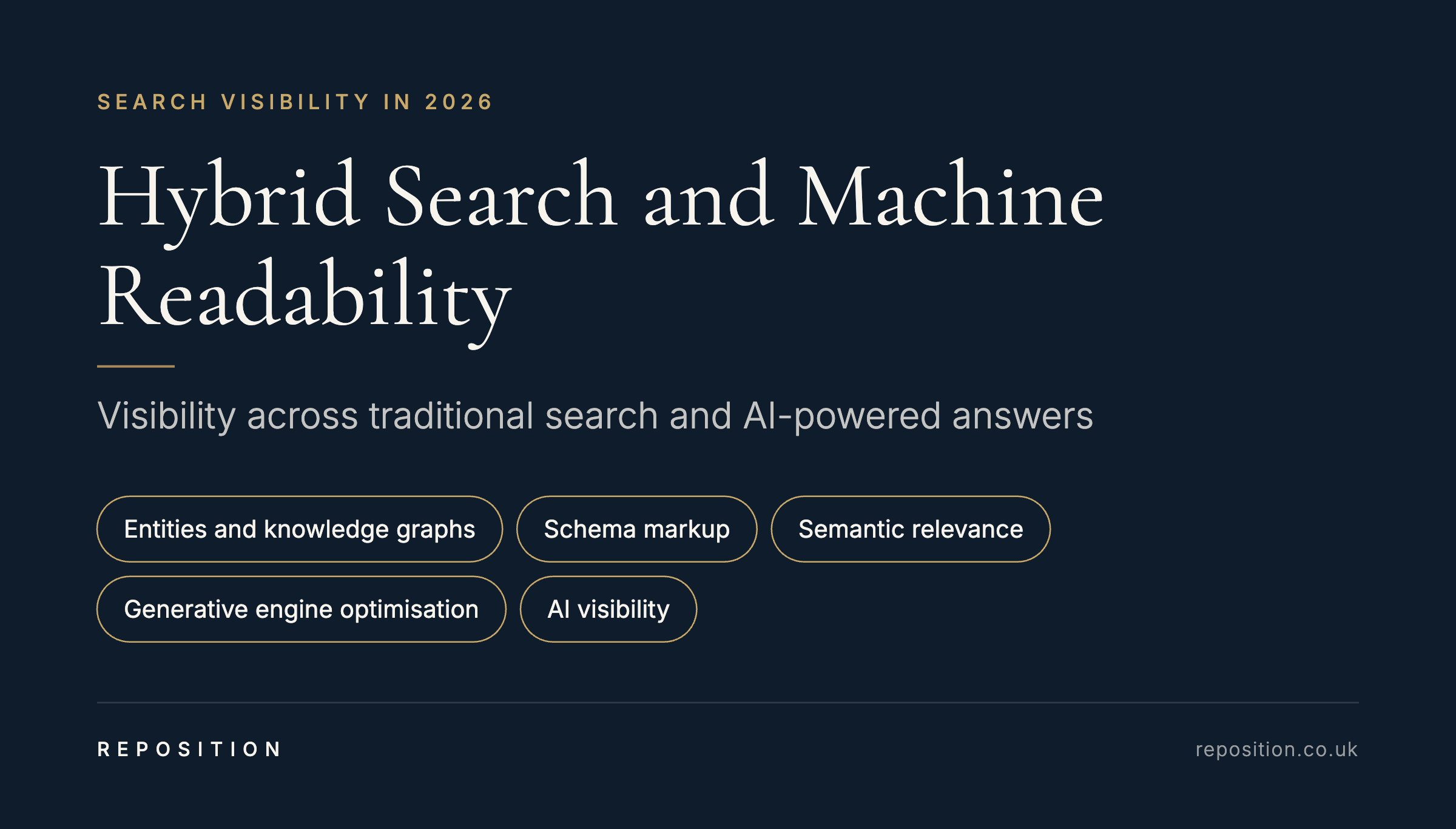
The way content earns visibility online has fundamentally changed. Ranking on page one is no longer enough, you need to be understood by machines that increasingly decide what gets surfaced, and to whom.
The Search Landscape Has Been Rewritten
Cast your mind back to 2022. SEO was still largely built around keywords, backlinks, and click-through rates. Today, the search results page — in many cases — no longer requires a click at all.
Google’s AI Overviews, Microsoft Copilot, and a new generation of answer engines including Perplexity and ChatGPT Search have redefined what “appearing in search” actually means. Users now receive synthesised, conversational responses drawn from multiple sources, with originating websites cited beneath — if they are cited at all.
This is hybrid search: an environment where traditional organic results co-exist with AI-generated answers, conversational interfaces, and machine-curated responses. For marketers and business leaders, it demands an entirely new strategic posture.
From Keywords to Knowledge: How Search Evolved
For two decades, search engines operated on a simple premise, match a query to a page containing relevant text. That model has been superseded by one rooted in understanding.
Today’s search systems don’t just crawl your page; they attempt to comprehend it. They identify entities, people, places, products, concepts, map relationships between them, and build a semantic picture of what your content actually means. This underpins how Large Language Models (LLMs) interpret the web.
The practical consequence: content that is well-written but poorly structured for machine interpretation may rank poorly or, worse, never appear in AI-generated answers at all.
Why Machine Readability Is Now a Core Visibility Factor
Machine readability is the degree to which AI systems and search engines can accurately parse, contextualise, and extract meaning from your content. In 2026, it is as strategically important as the quality of the writing itself.
Structured Data and Schema Markup
Implementing Schema.org markup is no longer optional. Schema tells machines not just what your page says, but what it is. FAQ schema transforms prose into directly extractable question-and-answer pairs. Article, Product, HowTo, and BreadcrumbList schemas each add layers of machine-interpretable context, making your content eligible for AI Overviews, rich results, and direct citations in generative responses.
Entity Relationships and Knowledge Graphs
Google’s Knowledge Graph — and the entity graphs used by other AI search systems — connect concepts, brands, and topics in a vast semantic network. When your content clearly establishes entities that align with those graphs, AI systems can position your brand within a trusted knowledge framework. This means referencing named experts, citing specific data, and building topical authority through interconnected content — not isolated keyword-targeting pages.
Semantic Relevance and Topical Depth
A well-structured pillar page, supported by interlinked cluster content covering related subtopics, sends a clear machine-readable signal: this source has comprehensive, authoritative knowledge. Fragmented content spread across poorly linked pages makes it harder for search engines and AI models to assess your expertise — and far less likely your content will be cited at all.
SEO, AEO, and GEO: A Unified Visibility Framework
The hybrid search era has elevated two disciplines from niche terminology into mainstream strategy.
Answer Engine Optimisation (AEO) focuses on structuring content so that answer engines select your source as the basis for their responses. It prioritises clear question-and-answer formatting, concise authoritative statements, and structured data that makes extraction straightforward.
Generative Engine Optimisation (GEO) optimises for how LLMs and generative AI systems discover, evaluate, and cite sources — including in ChatGPT, Gemini, Perplexity, and emerging AI agents. It demands genuine expertise, consistent entity signals, and a clear authorial voice that machines can attribute with confidence.
Neither replaces traditional SEO. They layer on top of it. Core Web Vitals, crawlability, and backlink authority remain foundational. AEO and GEO simply ensure that once your content is found, it is understood and trusted by the machines that increasingly mediate search.
Zero-Click Searches and the New Traffic Reality
AI-generated answers have accelerated an existing trend: a growing proportion of queries are now resolved directly on the results page, without a single click. This doesn’t mean organic traffic is dead it means it is changing in nature.
The traffic that does arrive is increasingly high-intent. Users who visit your site needed more than the AI summary could provide. This shifts the strategic priority: your content must earn the citation and the click, by demonstrating depth, original insight, and expertise that cannot be fully summarised in a paragraph.
Practical Recommendations for AI-Era Search
For SEO professionals and marketing directors navigating this landscape, the following actions are urgent rather than aspirational.
Audit your structured data coverage. Identify which pages lack schema markup and prioritise implementation for articles, FAQs, products, and service pages.
Build topic clusters, not keyword silos. Map your content architecture to demonstrate comprehensive topical authority through pillar pages and interlinked supporting content.
Write for extractability. Structure key insights as direct, standalone statements. Use clear subheadings and concise paragraphs that answer questions explicitly.
Establish entity clarity. Ensure your brand, key personnel, and subject matter are consistently referenced across your website, social profiles, and third-party citations.
Invest in genuine E-E-A-T signals. Named authorship, first-person expertise, original research, and real-world examples are the signals AI systems are trained to reward over generic, unattributed prose.
Looking Beyond 2026
The trajectory is clear. Search will continue to fragment across AI assistants, voice interfaces, agentic tools, and social discovery channels. The brands that maintain visibility across this expanding landscape will be those whose content is simultaneously compelling for humans and interpretable by machines.
Businesses that treat machine readability as a technical checkbox rather than a strategic content principle, will find themselves progressively invisible. Not because their content is poor, but because it is poorly understood.
At Reposition, we help ambitious businesses build content and SEO strategies that perform across traditional search, AI-generated answers, and the emerging discovery channels redefining how audiences find brands. If you are ready to future-proof your search visibility, speak with our team today.