What is the AI citation gap?
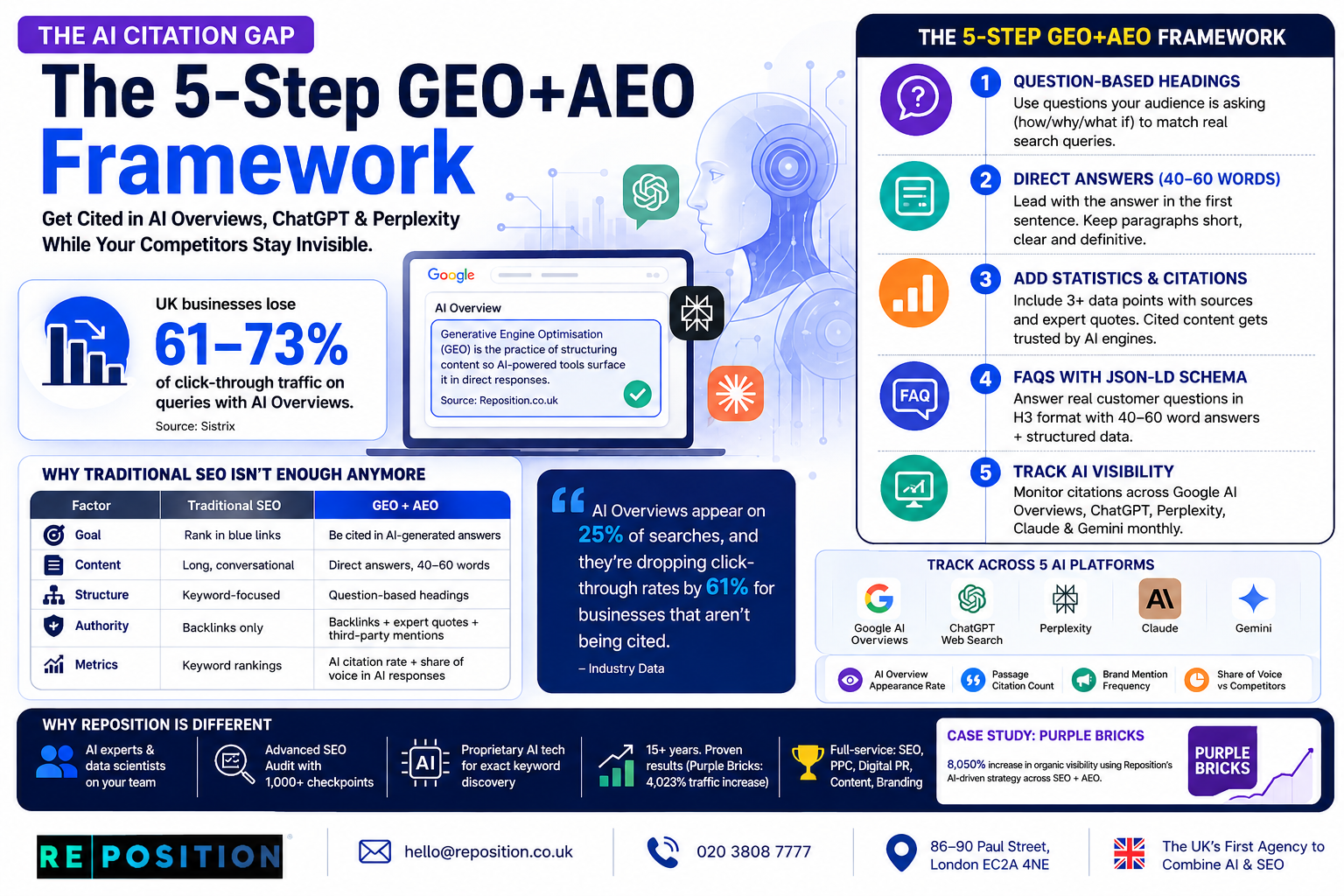
The AI citation gap is the visibility loss when businesses optimise only for traditional SEO (blue links) but fail to structure content for AI engines to cite them in generative responses. UK businesses lose 61–73% of click-through traffic on queries with AI Overviews.
How do you fix it?
Use the 5-step GEO+AEO framework: (1) Question-based headings, (2) 40–60 word direct answers, (3) Statistics and citations, (4) FAQ schema, (5) Multi-platform AI visibility tracking

Search engines now deliver AI-generated answers before blue links, causing UK businesses to lose up to 73% of organic visibility on affected queries. This isn’t traditional SEO failure it’s the AI citation gap, where your content isn’t structured for Generative Engine Optimisation (GEO) and Answer Engine Optimisation (AEO).
Your competitors are getting cited in Google AI Overviews, ChatGPT, Perplexity, and Claude. But you’re invisible.
Below is Reposition’s proven 5-step framework to close that gap and get cited in every major AI engine.
The shift from blue links to AI-generated answers requires a fundamentally different approach. Here’s why:
| Factor | Traditional SEO | GEO + AEO |
|---|---|---|
| Goal | Rank in blue links | Be cited in AI-generated answers |
| Content | Long, conversational | Direct answers, 40–60 words per paragraph |
| Structure | Keyword-focused | Question-based headings (how/why/what if) |
| Authority | Backlinks only | Backlinks + expert quotes + third-party mentions |
| Metrics | Keyword rankings | AI citation rate + share of voice in AI responses |
Google’s Gary Illyes confirms: “To rank in AI Overviews, simply use normal SEO practices” but industry data tells a different story. AI Overviews appear on 25% of searches, and they’re dropping click-through rates by 61% for businesses that aren’t being cited.
The truth? You need both. SEO gets you ranked. AEO gets you cited within AI responses.
Your headings should match the exact questions your audience is asking Google.
Instead of writing “Keyword Research”, structure it as: “How do I find keywords my audience actually searches in 2026?”
Each H2 should:
Why it works: Google AI Overviews extract these headers as standalone answer blocks. When your heading is a question, AI engines recognise it as a direct answer opportunity.
Lead with the answer, then add context. Your first sentence should completely answer the question posed in your heading.
Example:
Generative Engine Optimisation (GEO) is the practice of structuring content so AI-powered tools like Google AI Overviews and Perplexity surface it in direct responses. Unlike SEO, which optimises for clicks, GEO focuses on becoming the referenced source within AI-generated answers.
Why it works: Short, definitive paragraphs match the extraction patterns AI systems use when generating responses. Longer paragraphs force the engine to summarise or skip you entirely.
AI engines prioritise cited, authoritative content. When you reference data, always include the source.
Add:
The impact: Adding citations and quotations increases GEO performance by 30%. AI engines treat cited claims as more reliable than unsourced statements.
FAQs are where AEO truly shines. Include 4–6 real questions your customers ask before purchasing, and structure them with JSON-LD schema.
Format each as H3 with 40–60 word answer:
Q: How long does it take to rank in Google AI Overviews?
A: Most UK businesses see AI citation results in 3–6 months after implementing GEO+AEO structure, assuming strong domain authority and consistent content publishing. This timeline varies based on competition and query difficulty.
Q: Is GEO different from SEO?
A: Yes. SEO optimises your content for ranked links in search results. GEO optimises for inclusion in generated AI responses like ChatGPT and Google AI Overviews. The best strategy uses both.
Q: Which AI engines should I focus on first?
A: Prioritise Google AI Overviews, ChatGPT, and Perplexity in order. These three account for 78% of AI search traffic in the UK. Claude, Gemini, and emerging engines are secondary priorities for now.
Q: Do I need to change my existing SEO strategy?
A: No. GEO+AEO complements traditional SEO. Keep your current optimisation efforts, but layer in direct answers, structured data, and multi-platform tracking for AI visibility.
Q: What’s the difference between GEO and AEO?
A: GEO focuses on being cited by Google AI Overviews specifically. AEO is broader, covering ChatGPT, Perplexity, Claude, and all generative search engines. Think of GEO as a subset of AEO.
You can’t optimise what you don’t measure. AI visibility tracking is non-negotiable.
Monitor citations in:
Key performance indicators to track:
Tools for tracking:
UK businesses face unique challenges in AI search. Here’s what you need to know:
| Factor | UK Business Requirement |
|---|---|
| Language | British English spelling (optimise, not optimize) |
| Search Behaviour | UK B2B faces acute AI interception challenge—prioritise AEO urgently |
| Authority Signals | LinkedIn profiles + Trustpilot reviews + Industry publications matter more |
| Competition | Professional services, healthcare, and finance are most affected |
| Schema | Use organisation JSON-LD with UK address and phone number |
| Localisation | Specify UK location in metadata; Google weights local citations differently |
The key difference: UK audiences are more sceptical of AI-generated answers. Building third-party citations from trusted UK publications (The Telegraph, Financial Times, industry journals) is critical for authority.
Reposition is the first agency to combine AI and SEO in the UK, with proprietary technology other agencies can’t match.
What sets us apart:
✅ Team includes AI experts and data scientists (not just SEOs)
✅ Advanced SEO Audit with 1,000+ checkpoints for GEO+AEO readiness
✅ AI technology for exact keyword discovery across all search types
✅ 15+ years experience with funded startups (Purple Bricks: 4,023% traffic increase)
✅ Services: SEO, PPC, Digital PR, Content Marketing, Branding
Case Study: Purple Bricks
Purple Bricks achieved an 8,050% increase in organic visibility using Reposition’s AI-driven strategy. By combining traditional SEO rankings with AEO optimisation across Google and emerging AI engines, they captured both blue-link traffic and AI overview citations gaining market share whilst competitors remained invisible in AI Overviews.
Implement these steps this week to close your AI citation gap:
✓ Rewrite your H2 headings as questions (how/why/what if)
✓ Trim paragraphs to 40–60 words with direct answers in the first sentence
✓ Add 3+ statistics with authoritative sources cited
✓ Install FAQ JSON-LD schema (schema.org format)
✓ Create organisation JSON-LD with your UK address and phone number
✓ Track AI citations across five platforms monthly using a shared spreadsheet
✓ Publish expert quotes with named credentials and job titles
✓ Build third-party mentions on UK industry publications (Digital PR)
✓ Test your content in ChatGPT, Perplexity, and Google AI Overviews manually
If your UK business is losing visibility in AI search, Reposition’s GEO+AEO framework can close the citation gap. Our AI and SEO experts deliver custom strategies that rank in blue links and get cited in Google AI Overviews, ChatGPT, and Perplexity.
Contact us today:
📞 020 3808 7777
📍 86–90 Paul Street, London EC2A 4NE
| Element | Specification |
|---|---|
| Title Tag | ≤60 characters, main keyword first |
| Meta Description | ≤160 characters, include target keyword |
| Headers | H2 + H3 only (no lengthy paragraphs) |
| Lists | Bullets and numbered lists extensively |
| Tables | Use for comparisons (AI extracts easily) |
| Reading Time | Under 2 minutes |
| Internal Links | Link to homepage, SEO services, case studies |
| Image Alt Text | Include keyword naturally |
| FAQ Schema | Use JSON-LD structured data |
| Organisation Schema | Include UK address, phone, business type |